Submitted by Andrew.Chaney@m... on
Why conventional tap aerators may not be appropriate for healthcare environments — and what to specify instead.
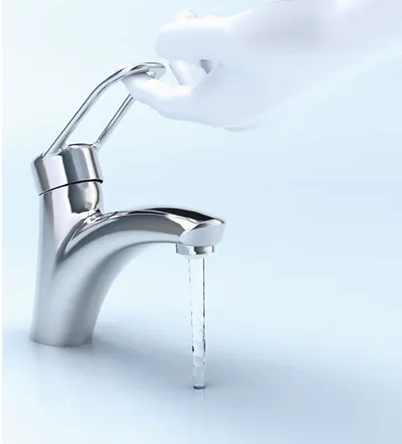
In a conventional domestic or commercial basin, a tap aerator is often taken for granted. It produces a comfortable, splash-free stream while reducing water consumption.
In healthcare environments, however, the end of the tap deserves considerably more attention.
The terminal outlet is one of the areas of a tap that can come into contact with water, air, scale and contaminants. In a healthcare environment, where patients may be particularly vulnerable to waterborne pathogens, the design of the outlet can therefore form part of the overall infection-control strategy.
Increasingly, healthcare guidance and research are questioning the use of conventional aerators and drawing attention to non-aerating, hygienic outlets.
What is an aerator?
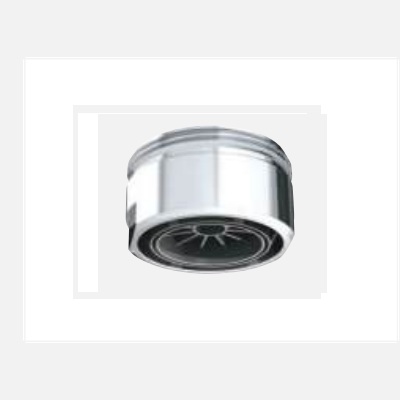
A conventional tap aerator uses a small internal screen or mesh to introduce air into the water stream.
The result is a soft, aerated flow that feels comfortable and helps prevent splashing. This is perfectly appropriate for many domestic applications.
The problem in healthcare is that the very features that make an aerator effective can also create potential hygiene concerns.
The internal mesh and components provide additional surfaces in contact with water. They can collect scale and other deposits and provide areas where microorganisms and biofilm may develop.
Aeration also introduces air into the water stream, which can increase aerosol generation.
This is particularly relevant because healthcare handbasins can be associated with splashing and aerosolisation of microorganisms originating from contaminated plumbing and drainage systems. Recent research has demonstrated viable multidrug-resistant organisms in aerosols generated during handbasin operation in hospital environments. (Journal of Hospital Infection)
Why is this particularly important in healthcare?
Healthcare-associated infections can involve organisms such as Pseudomonas aeruginosa, Legionella and other opportunistic pathogens.
Biofilm is an important part of the problem. Once microorganisms establish themselves on a wet surface, the resulting biofilm can provide protection and make eradication more difficult.
The terminal parts of a tap are particularly relevant because they are directly associated with the point where water leaves the fitting.
Delabie's healthcare guidance has long recognised this issue. Its healthcare catalogue identifies the terminal area of the tap and outlet as an area requiring particular attention and promotes designs with smooth internal surfaces, low water volume and reduced opportunities for bacterial development.
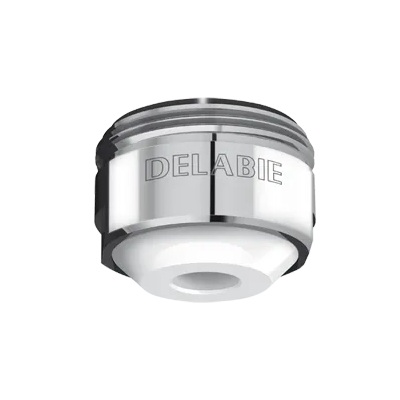
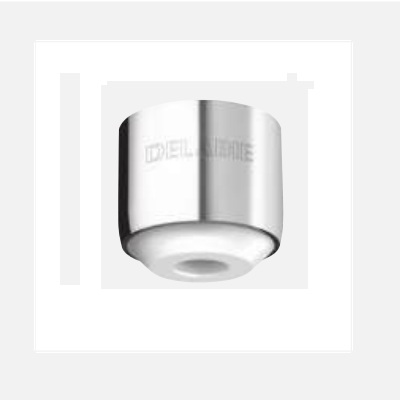
The catalogue specifically describes its BIOSAFE outlet as having a smooth internal surface with no grid, partitions or star-shaped structure, reducing opportunities for impurities and scale to adhere.
What does current guidance say?
The International Health Facility Guidelines (iHFG) take a particularly clear position. Their current water-systems guidance states that flow restrictors and aerators should not be provided at basin or sink outlets in healthcare facilities.
The guidance identifies two concerns: these components can provide locations where bacterial growth can occur, and they can restrict the higher flows required for healthcare handwashing. It also states that spray-type mixer taps should not be used in healthcare facilities. (International Health Facility Guidelines)
This is an important distinction.
The objective shouldn't simply be to replace an aerator with another small device at the end of the tap. The objective should be to design the tap and outlet so that the required flow rate and splash control are achieved without unnecessarily introducing additional internal components, mesh or water-retaining areas at the point of discharge.
Laminar flow isn't necessarily the whole answer.
There has been increasing discussion around replacing aerators with laminar-flow devices.
There is good reasoning behind this. Unlike an aerator, a laminar-flow outlet does not intentionally entrain air into the water stream and can therefore reduce aerosolisation associated with the outlet.
However, we believe the terminology needs to be used carefully.
“Laminar flow” describes the characteristics of the water stream. It does not necessarily describe the internal construction of the outlet.
A device can produce a laminar stream while still containing internal components that provide surfaces or areas where deposits and biofilm can accumulate.
This is why we recommend looking beyond the label and considering the actual design of the outlet.
What should a healthcare tap outlet look like?
For healthcare applications, the preferred approach should be an outlet that:
- Does not intentionally introduce air into the water
- Has no fine mesh or conventional aerator screen
- Minimises internal surfaces and components
- Minimises areas where scale and debris can accumulate
- Minimises retained or stagnant water
- Has smooth internal surfaces where possible
- Provides a controlled, non-splashing stream
- Can be readily cleaned or replaced where required
- Is compatible with the required flow rate for the application
This is why a hygienic, non-aerating outlet is a more useful specification than simply stating “laminar flow outlet”.
Keep the flow control inside the mixer.
There is another important consideration: flow rate.
Many conventional basin taps use the aerator itself to control the final flow rate. Removing the aerator without considering how the flow is controlled can result in excessive flow and splashing.
The preferred approach is to control the flow within the tap or mixer itself, while keeping the terminal outlet as open and hygienic as practical.
For example, Delabie's healthcare basin mixers incorporate flow-rate limitation within the mixer, with its mechanical basin mixers specified at 5 l/min at 3 bar.
This means the terminal outlet does not need to perform the job of being both a flow regulator and a water-conditioning device.
Control the flow upstream. Keep the outlet simple.
The Delabie approach: BIOSAFE.
Delabie's BIOSAFE philosophy is based around reducing the opportunities for bacterial development within water controls.
The approach includes:
- low volumes of standing water;
- smooth internal surfaces;
- reduced numbers of components in contact with water;
- removable components where cleaning and disinfection are required; and
- hygienic terminal outlets.
Delabie's BIOSAFE outlet is particularly relevant to this discussion. Unlike a conventional aerator, it is a free-flow outlet with no grid or internal partitions in contact with the water, designed to minimise internal water retention.
The catalogue also states that the outlet should be used with a tap that already has a restricted flow rate, ensuring a good flow without splashing.
This provides a useful example of the overall design philosophy: Don't rely on the terminal outlet to do everything. Design the mixer, flow control and outlet as a complete hygienic system.
The evidence is evolving.
It is important not to suggest that there is a single design feature that eliminates infection risk.
The latest research shows that healthcare handbasin design is a complex issue involving the tap, outlet, basin, waste, drainage, splash patterns, flow rate and operational practices.
A major review published in the Journal of Hospital Infection in August 2026 examined healthcare handbasin guidance from 39 countries. It found considerable variation between guidelines and highlighted continuing uncertainty around the optimum combination of outlet fittings, flow rates and faucet operation. The authors concluded that future designs need to balance biofilm control, splashing and aerosol reduction, clinical handwashing requirements, water efficiency and scald prevention. (ScienceDirect)
Other 2026 research has further demonstrated that operation of contaminated hospital handbasins can contribute to aerosolisation of viable microorganisms, reinforcing the importance of considering the complete basin and tap environment rather than the tap outlet in isolation. (Journal of Hospital Infection)
So the message isn't: “Aerator bad, laminar good.”
It is: “Consider the complete hygiene characteristics of the tap and outlet, and minimise unnecessary opportunities for biofilm, water retention, aerosolisation and splashing.”
Our recommendation:
For healthcare basin applications, we recommend that conventional aerators are not specified.
Instead, specify a hygienic, non-aerating outlet with minimal internal components, no fine mesh or conventional aerator screen, minimal water retention and a controlled, non-splashing flow.
Where flow limitation is required, this should preferably be incorporated into the mixer rather than relying on a restrictive terminal aerator.
This approach aligns with the direction of current healthcare guidance and with the hygienic design principles incorporated into Delabie's healthcare products.
In simple terms:
Conventional aerator
Introduces air + contains mesh/components + can retain deposits
→ Avoid in healthcare
Generic laminar-flow device
Does not aerate water + potentially lower aerosolisation
→ Consider the internal design carefully
Hygienic non-aerating outlet
Minimal internal components + no mesh + minimal water retention + controlled flow
→ Preferred approach
The specification matters.
For architects, engineers and healthcare specifiers, simply writing “laminar flow outlet” may not be sufficiently specific.
A more robust specification would describe the required characteristics of the outlet, including: Non-aerating hygienic outlet with no fine mesh or aerator screen, minimal internal water retention and smooth internal surfaces, designed to provide a controlled, non-splashing flow. Flow limitation to be provided within the tap/mixer rather than by a conventional aerator at the point of discharge.
This focuses the specification on the hygiene performance of the outlet, rather than simply its name.
Why we think this matters.
In a healthcare environment, the last few millimetres of a tap may seem insignificant.
But that is precisely where the water leaves the fitting and enters the environment.
If we can remove unnecessary mesh, reduce water retention, minimise internal surfaces and avoid deliberately aerating the water — while still providing a comfortable, controlled flow — there is little reason to introduce those additional components in the first place.
Simple at the outlet. Hygienic by design.